


From Country to Commercial Space: Lucinda Johnson-Cornes and the Art of Reconciliation in Design
At its heart, National Reconciliation Week, observed each year from 27 May to 3 June, is about the relationships that make reconciliation real. The ones built in communities, in workplaces, and in the spaces we all move through. At Winya, that belief has always been grounded in the built environment: in the furniture that anchors a public space, the textile that draws a passer-by into a moment of pause, and the career pathway that transforms aspiration into professional reality.
The Yanada Lounges at Melbourne Central Shopping Centre are one such answer.
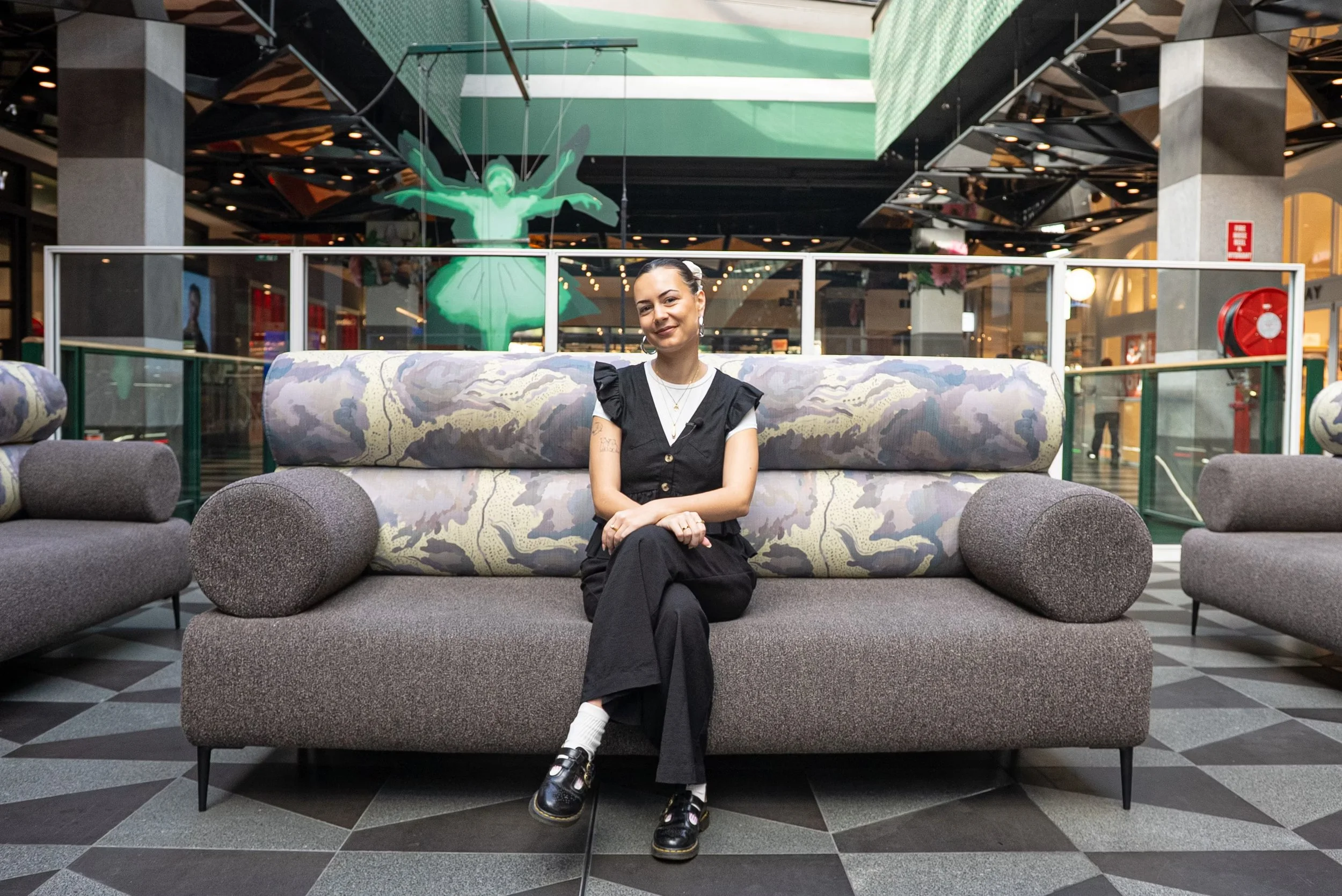
Lucinda Johnson-Cornes sitting on a Yanada Modular Lounge upholstered with her design (Credit: GPT Group)
A Creative Practice Rooted in Country
Lucinda Johnson-Cornes is a proud Pitjantjatjara woman and recent RMIT University graduate, holding a Bachelor of Textiles (Design) with Honours. Her practice is grounded in storytelling, weaving narrative through colour, texture and intuition. Growing up in Victoria's Macedon Ranges gave her an intimate relationship with landscape, and that deep familiarity with Country infuses her work with quiet authority.
"I was inspired by the beautiful environment of the Macedon Ranges where I grew up," Lucinda explains. "I was also specifically interested in the pattern of gum tree trunks up close. It's like a collision of so many different colours, shapes and movement when you look closer. I was hoping to capture some of that soft movement and colour variety in the painting."
The result is a fluid, intuitive composition in purples, mauves and greens that speaks to the specificity of place and to something universally restorative. It is the kind of work that stops you mid-stride.
The Work Placement That Opened Doors
During her studies at RMIT, Lucinda undertook a work placement with Winya, one that proved formative for both sides of the partnership. For Lucinda, it was an opportunity to understand how cultural expression can hold real commercial relevance. For Winya, it was a chance to discover an exceptional talent and invest in her trajectory.
"Luci’s involvement in the work placement exceeded expectations," said Justine Davis, Winya’s VIC & WA State Manager. "It was clear to us that she has a real talent for textile design, and we're excited to see where her career takes her."
The placement also deepened Lucinda's confidence in her own identity. Her time at RMIT, and her connection with the university's Ngarara Willim Centre, had already supported her to reconnect with culture, a personal journey that directly shaped the authenticity of her design practice.
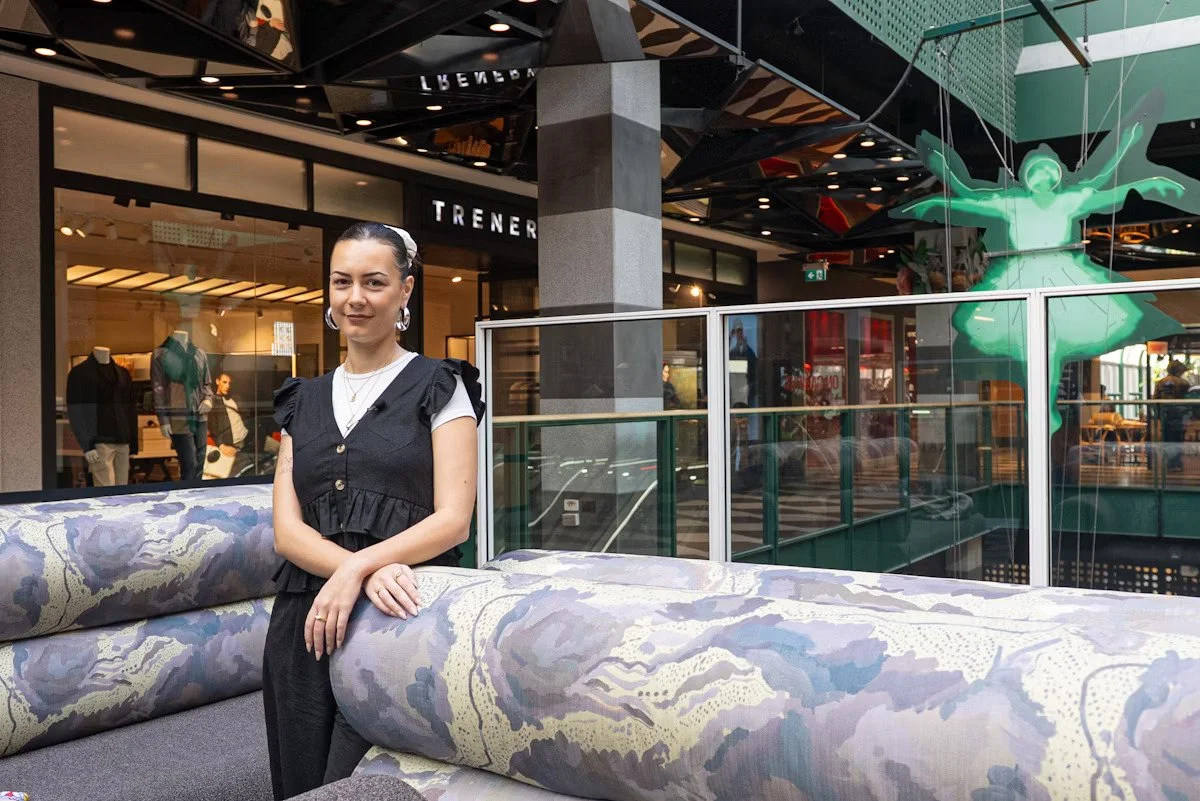
Lucinda Johnson-Cornes next to a Yanada Modular Lounge upholstered with her design (Credit: GPT Group)
Reconciliation Made Tangible at Melbourne Central
The Yanada Lounges are more than a procurement outcome. Installed throughout Melbourne Central, one of the country's busiest retail destinations, they bring First Nations storytelling into a space traversed by millions of people each year. For Lucinda, who spent four years commuting through Melbourne Central as an RMIT student, the installation carries particular resonance.
"It's super special," she says. "I mean, commuting to uni and to the city I have spent countless hours going through Melbourne Central. It is such a busy hub of Melbourne life, and knowing the amount of people that pass by and interact with the pieces is so surreal."
This is reconciliation in material form: First Nations art embedded into the everyday fabric of commercial life, not as gesture, but as real design intent. The lounges do not simply reference culture; they enact it, creating what Lucinda herself describes as "pockets of peace" within a high-traffic urban environment.
What This Means for Designers and Specifiers
For architects and interior designers, the Yanada Lounges offer a compelling model for meaningful Indigenous engagement in commercial projects. Winya's procurement framework is designed to make this kind of collaboration accessible and easy to navigate, connecting studios and project teams with First Nations artists and businesses in ways that create lasting economic and cultural impact.
Specifying Winya is not only an aesthetic decision. It is a contribution to a procurement ecosystem that funds real career pathways, supports remote community employment, and honours the United Nations Sustainable Development Goals. It is, in the clearest sense, design that does more.
The Work Continues
The story of the Yanada Lounges is the kind that stays with us well beyond the 3 June close of Reconciliation Week. Not because it fits a theme, but because it is exactly the kind of tangible, lasting outcome that reconciliation in commercial life can produce: a First Nations artist given real platform, a career actively invested in, and a public space transformed.
Lucinda Johnson-Cornes is entering a profession that needs her voice. The Yanada Lounges at Melbourne Central are proof of what becomes possible when that voice is truly invited.
Winya Indigenous Furniture partners with architects, designers and procurement teams to deliver First Nations–led commercial furniture solutions across Australia. To learn more about our Indigenous Procurement Program and work placement opportunities, .
